Meet Ella Comberg, HIAA BA ‘20
PhD Student at Princeton University
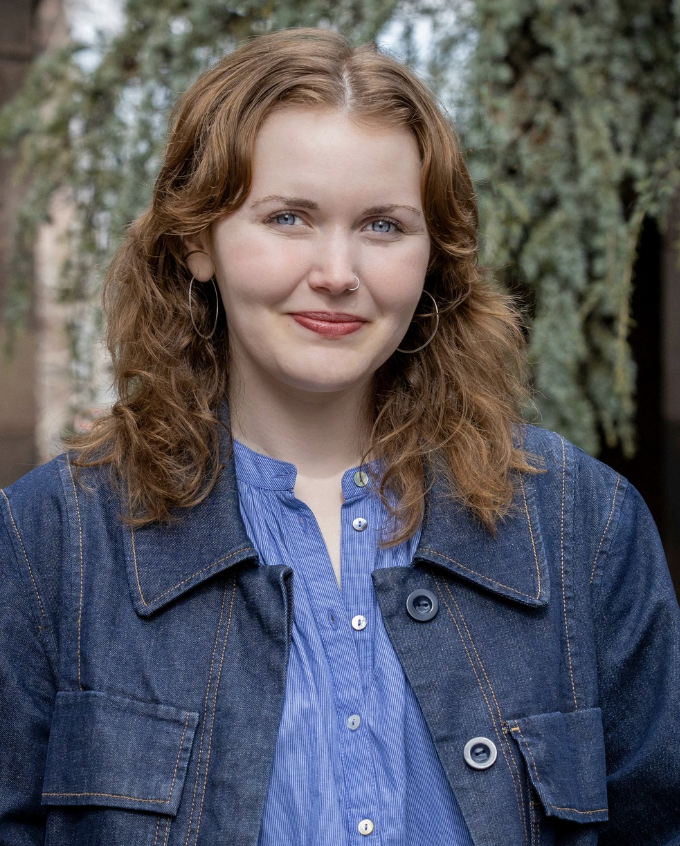
Ella Comberg is currently a PhD student in the Department of Art & Archaeology at Princeton University studying twentieth-century American art with a focus on the relationship of the visual arts to science and technology. She graduated from Brown with a BA with Honors in HIAA and Urban Studies. Later she earned her MA from the Graduate Program in the History of Art at Williams College, where she was awarded the Clark Graduate Prize for her qualifying paper, “‘Other Selves’: Gregory Bateson’s Cybernetic Anthropology at the Museum of Modern Art, 1943.”
What excites you most about your current work?
I’m now in my seventh year of art historical education but I still find, as I’m sure I will for the rest of my career, that there is still so much to learn, even in texts I’ve read many times before. It’s really interesting to come back now to texts I read in college. I can appreciate what I was able to understand on my first go-around with minimal contextual information. At the same time, there is so much more to absorb now that I’ve filled in a lot of the gaps. Many academic texts operate within a discourse with its own set of references, methods, and implicit assumptions. While this can feel alienating at first—and while I would never endorse writing that is intentionally abstruse—it’s really rewarding to spend enough time in a field that you are able to parse the unspoken elements of a text, primary or secondary.
I still remember reading Rosalind Krauss’s essay on Picasso’s dealer, Daniel-Henry Kahnweiler, for Professor Lindsay Caplan’s seminar Abstraction in Theory and Practice (the course, by the way, that made me want to be a modernist art historian). I read it slowly, again and again, in Coffee Exchange. I didn’t understand it very well, but what mattered was learning how to work through the text, rather than absorbing precisely all of its arguments. I would probably understand much more, but not everything, in that text if I re-read it now. I very much like this iterative quality of academic study. You can feel your brain change as you come back to the same object or text over and over. This is very empowering.
Second, I am very social and extroverted. This is not the case for all academics! People often refer to academia as monastic, and there is truth to this. But one of my favorite things about my work is its sociality. I just presented my first paper at the College Art Association annual conference, and it was so rewarding to meet other scholars in my sub-specialty, modern art and technology, who are working through similar questions to me. Additionally, our field is tethered to a public-facing profession by way of museum work. In my opinion, this is a strength. When I worked at the National Gallery of Art, I spent a lot of time walking around the museum, looking at people looking at art, and talking with visitors when I could. At its best, our field is truly impactful in public, social life. And even when academia is at its most monastic, you are still always in dialogue with other thinkers, dead and alive, from your sources for an article to your advisor to your readers. Writing in a museum context has a crucial place in our society, and its audience is quite large. But so too, I think, does academic writing with its comparatively narrow audience. People often malign “writing for one person” (i.e., your professor or dissertation advisor). To me, narrowness is not inherently a fault. It’s often where thinking happens.
I’m currently in my first year of my PhD…
in the department of Art & Archaeology at Princeton University. I spent many years after undergrad debating whether I wanted to pursue a PhD. It felt like a big sacrifice financially and a huge time commitment—both of which are true and important considerations. For that reason, I didn’t apply until I felt confident about the decision and truly ready. For me, this meant first pursuing an MA at the Williams College/Clark Art Institute program, which helped orient me in the field and think about whether I wanted to seek professional positions in the arts or get a PhD. I would recommend, pretty universally, working in whatever way you can for a few years after college (even in a service position or something that has nothing to do with art history) and/or seeking a funded MA before applying to PhD programs. This time is helpful to really consider the decision and what the other options might be. Both intellectual and professional skills are important, and the most successful people in the arts find ways to combine them. Try to get experiences that expose you to both ways of working and thinking and never disparage the other whole cloth.
That said, it can be very challenging to watch your peers at Brown get high-paying jobs immediately after graduation that affirm a sense of professional identity. Unfortunately, this is very rare in the arts. It takes much longer to find a permanent, full-time position. I spent many years feeling demoralized to still be an intern while my friends were working in more traditional roles. My advice is: stick with it!
As one of my Brown professors told me, all good jobs are dues-paying jobs. I feel that very deeply, including now in my PhD. The dues I pay are working long hours and living in suburban New Jersey rather than a major city, but I feel it’s worth it for the benefits: thinking, reading, and seeing like-minded colleagues every day. To me, these are immense privileges.