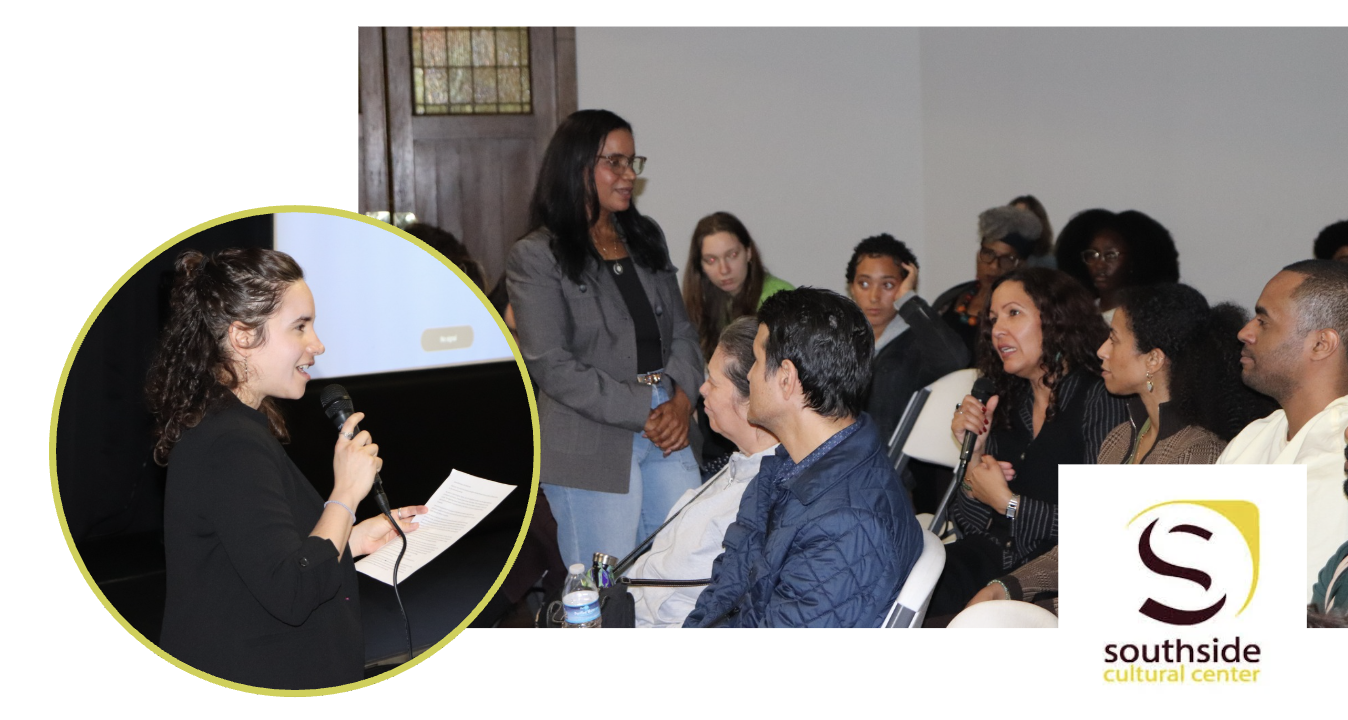
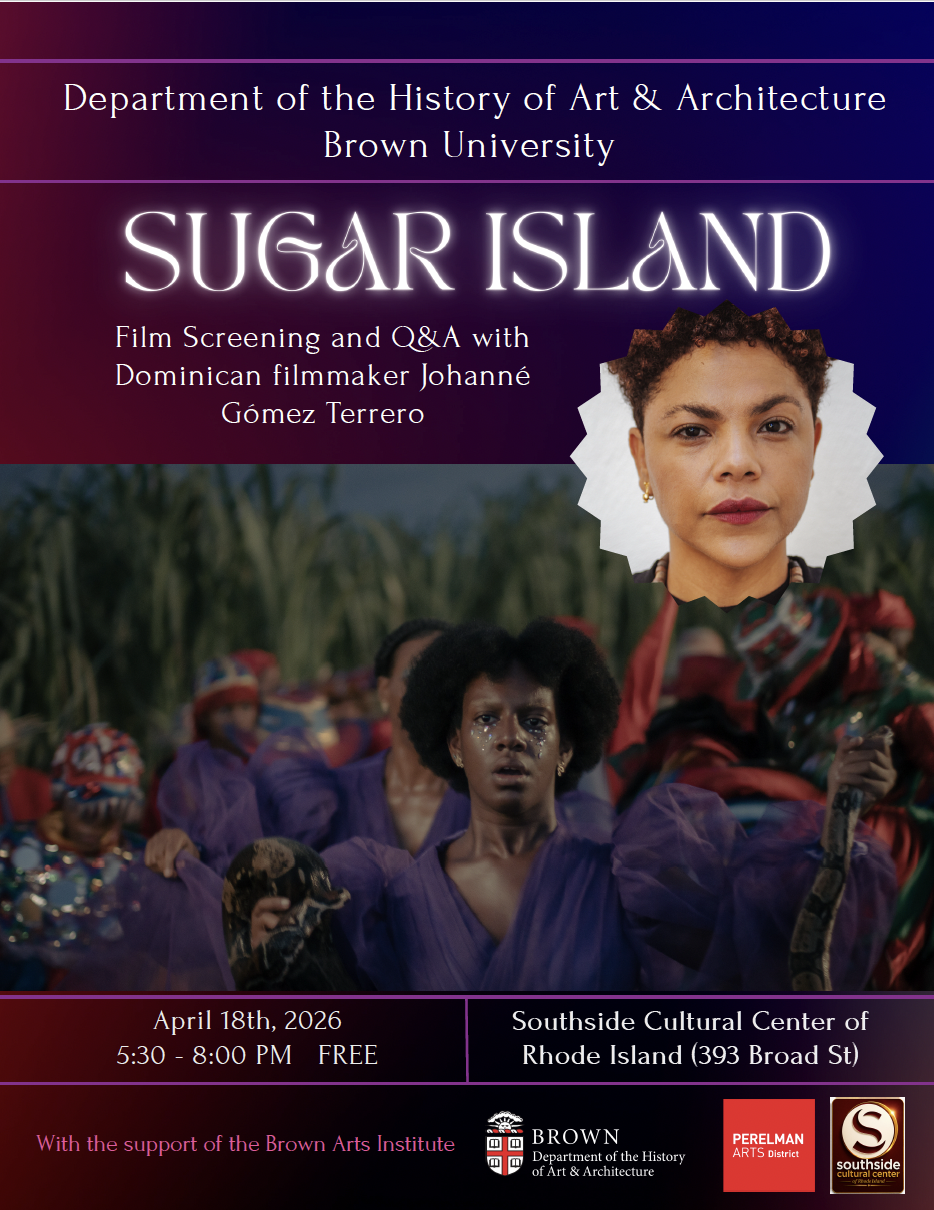
 This spring, HIAA Presidential Postdoctoral Fellow Celia Rodríguez Tejuca organized a special film screening in partnership with the Southside Cultural Center of RI (SCCRI) of “Sugar Island", directed by Dominican filmmaker Johanné Gómez Terrero. The event enabled undergraduate students of Rodríguez's spring course “The Repeating Island: Visual Cultures of the Early Modern Caribbean," to watch and consider the film together with Providence's Dominican community members. Well attended, the screening was followed by discussion with Johanné Gómez Terrero moderated by SCCRI staff member Candida De La Rosa.
“Sugar Island”, directed by Dominican filmmaker Johanné Gómez Terrero, follows Makenya, a Dominican-Haitian teenager, as she navigates an unwanted pregnancy and the harsh labor that defines her world. As Makenya confronts family burdens and the specter of displacement, a mysterious theater troupe’s arrival illuminates the haunting connections between past and present struggles.
 Students in Rodríguez's “Repeating Island” course found watching the film off campus and in community to be both memorable and impactful.
“I found the overall experience of witnessing Sugar Island at the SCCRI to be wonderful. It was a rare opportunity to engage with the community… The themes of the film were highly relevant to our course, as it felt like a culminating anchor to the different histories we’ve explored in class. With the history of Hispaniola often told through colonial objects, the film provided an uncommon insight into how current societal issues are shaped by the violences of the past. Additionally, it offered accounts of how Indigenous religions and cultures were not necessarily erased, but instead endured and evolved alongside the melting pot that is the present-day Dominican Republic. It also shed light on the question of who gets to claim ownership of land; one line that stayed with me was the idea that those who work the land deserve the right to live on it (paraphrased).” - Maria Deiparine
“I am very glad I was able to watch the film. My second concentration is going to be in education, and in my education classes, we often talk about grounding our discussions (especially historical discussions) with modern media and narratives. I think that empathy and understanding are developed a lot more easily when students have someone specific to root for and when we can see the connections between the histories we learn about and our own lives. The film placed many of the issues we discuss in our class, like colonialism, racism, religious conversion, slavery, and construction of plantation societies/economies, in modern terms, both illuminating parts of history and how those histories impact us today. The film also introduced a lot of new ideas to me, specifically about gender and sex in the Caribbean, however, these ideas also connected to discussions of abortion as means of liberation we had in class. It was especially valuable to watch the film at the SCCRI because we were able to hear what community members thought, and also see how passionate community members are about this film and what it represents. Not to mention how cool it was to be able to speak with the director themself. I found it really interesting to learn that the film had to be shot in 5 weeks because the modern owners of these plantations don't support such a film being made. I knew that the events in this movie were grounded in real tensions, but learning about the resistance to this very film existing was eye opening.” --Elly Hempstead
"I really appreciated the off-campus screening of Sugar Island as part of Professor Rodríguez Tejuca’s History of Caribbean Art class. I appreciated this for one, because members of the broader Providence community were able to be involved - and Providence beyond College Hill is filled with Spanish speaking individuals and people of either Dominican or Haitian descent as well (just thinking of how big of an immigrant population Providence has) so I think being able to get them involved was really powerful and something that Brown as a whole needs to do a better job of doing so I really appreciate this on our Professor’s end of bridging that gap and working to build that connection.
"Sugar Island", Spain/Dominican Republic, 2024, in Haitian and Spanish (with English subtitles), 91 minutes, directed by Johanné Gómez Terrero.