![]() Antonio Parra’s Curious Cabinet: Crafting Imperial Desire in Colonial Havana
Antonio Parra’s Curious Cabinet: Crafting Imperial Desire in Colonial Havana
Celia Rodríguez Tejuca, Presidential Postdoctoral Fellow and Research Associate in HIAA, was recently published in The Art Bulletin. Her article “Antonio Parra’s Curious Cabinet: Crafting Imperial Desire in Colonial Havana," follows naturalist Antonio Parra, who was active in eighteenth-century Havana. Parra developed an innovative method for fish taxidermy, showcased these specimens in a wondrous natural history cabinet, and publicized the efforts in the first intaglio-printed book in Cuban history. Rodríguez' article interrogates the sociopolitical dimensions embedded in such epistemic visual artifacts, revealing how Parra’s interlinked efforts redefined colonial participation in Crown-sponsored knowledge-gathering projects and fostered an imperial acquisitiveness from peripheral positions within the Spanish domains. As doing so depended upon leveraging local materials and subaltern labor, this article ultimately assesses the dynamics of visibility and concealment as representational strategies underpinning colonial science.
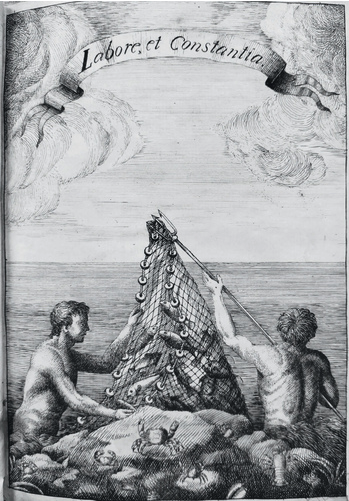
Image: Manuel Antonio Parra (b. 1768), frontispiece with fishing scene and “Labore et Constantia” motto, from Antonio Parra (b. 1739), Descripción de diferentes piezas de historia natural las más del ramo marítimo, Havana: Imprenta de la Capitanía General, 1787, etching and engraving, 33 × 7⅜ in. (13 x 18.8 cm). Biblioteca Nacional de Cuba José Martí, Havana (© Biblioteca Nacional de Cuba José Martí; photograph by Celia Rodríguez Tejuca)